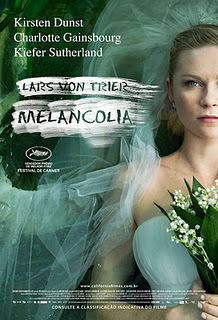
Take Shelter from Melancholia by Surviving Progress

I suppose it’s appropriate that with today’s economic and environmental disasters looming large, we are seeing a number of films predicting the end of mankind in ways from which we cannot protect ourselves. 

Three new films that I saw recently in close proximity, all spelled out our doom in very different ways, with little or no hope of survival. Perhaps the current global economic crisis has people wondering what we’ve gotten ourselves into and how the end will come, instead of how it can be prevented. It’s as if we know that we cannot save ourselves from our own destructive nature, and we expect the Earth to retaliate for our blatant abuses and tell us that our time is up. Will the end of our planet be our own undoing, or will it come through some natural, unstoppable disaster?  

These three films all explore the inevitable global end and extinction of mankind on Earth. Two of them by natural phenomena from which there is no protection; Melancholia and Take Shelter, and if that doesn’t humble you, there is a documentary that very clearly illustrates how we will be the architects of our own demise; Surviving Progress

Melancholia and Take Shelter are both about individuals looking up at the sky and, through instinct or visions or dreams, somehow sense a coming global disaster, but are unable to express this to others except by what appears to be very unusual and disturbing behavior to the people around them. Both movies center on this person and their strange behavior and the effect it has on their family or community. When the disaster eventually strikes, they seem to be the ones, at least mentally, to be most prepared for it, if not physically. 

Visually both these films are appropriately ominous and eerily photographed with dreamlike, nightmare images and minimal visual effects. As these films are dramas that focus on intimate human relations rather than the physical destruction of the planet, as with Roland Emmerich’s 2012 (2009), they are slow and pensive films that can be depressing and boring for some.

Surviving Progress is a documentary about our capacity to kill the planet and ourselves along with it. It argues that, while we as a society have progressed in our technology and our culture has changed as a result, we, as people, still have all the same primitive instincts of our hunting and gathering ancestors, and that, what we call progress, is actually becoming detrimental to our survival.

Our ability to question ‘why?’ has made us successful in the past but we are now too successful to the point that we are destroying ourselves and the planet. The same abilities that helped us survive in our early history are destroying our planet today. To illustrate this, the movie uses an example from our past, when, as cavemen, we hunted Mammoths to sustain us with food and tools, and we became good at killing them. But eventually we became too good when someone figured out that we could kill many Mammoths at once by herding them over a cliff. Mammoths quickly became extinct, depriving us of an important renewable resource that would have sustained future generations indefinitely. We still have the same mentality today. Consumerism is destroying us and our planet, whether we are stuffing our bodies with food or stuffing our houses with stuff, we are literally consuming ourselves to death.

The film now turns to Wall Street, which is seen as an oligarchy of affluent people with political power to effect change to benefit their cause, which is to make more money and become more affluent. Corporations and economists, says David Suzuki, are totally out to lunch with their economic model of growth, which is completely unrealistic for our world. Corporations and the affluent would rather see 90% of the planet’s people starve and die, and see all the planet’s forests and resources destroyed before ever giving up their desire for more wealth.

We have gone from destroying Mammoths to plundering the last of our natural global resources with no thought for the future. It’s a grim tale of human greed and ignorance that will make Melancholia and Take Shelter seem like the justice we deserve. But as a character from Melancholia says ‘Don’t grieve for the Earth, the Earth is evil.’ And an expert in Surviving Progress characterizes humans as behaving like a virus, killing everything in its path. 

JP

My favourite films of 2011

So here is my list of favorite films that I saw during the 2011 film year so far. I have obviously not seen every film that was released this year and I will probably see more films from 2011 in the future that I might want to add to this list, but of the 75 films that I did see in 2011, these were the ones that I enjoyed watching most and would watch again. Films that I saw that didn’t make this list may also have been good, but I would probably not consider watching them more than once.  

My criteria for this list are naturally subjective as everyone has their own taste but for me a film must have the following: visually it should be unique, bold and stimulating, in other words, the world that has been created must be immersive and authentic with a consistent visual style. The story concept should be interesting, suspenseful and character driven. Performances should be logical and realistic given the situation, character and style of the film, and it should be an emotionally engaging experience overall. (Not too much to ask, is it?)

It was a particularly good year for Sci-fi/fantasy and Feel Good/Comedy/Romances, and there were also some high points in Animation and Foreign films. Below is my list organized by Genres and then in chronological order of release date. (Click on the highlighted films to read my reviews)

Sci-fi/fantasy:                                                                   Director
The Adjustment Bureau                                                      George Nolfi    
Battle: Los Angeles                                                            Jonathan Liebesman
Source Code                                                                      Duncan Jones
X-Men: First Class                                                              Matthew Vaughn
Super 8                                                                              J.J. Abrams                 
Green Lantern                                                                    Martin Campbell
Attack the Block                                                                 Joe Cornish                 
Cowboys & Aliens                                                              Jon Favreau
Rise of the Planet of the Apes                                            Rupert Wyatt     

Action Adventure/Suspense thriller:
The Eagle                                                                            Kevin Mcdonald           
The Devil’s Double                                                              Lee Tamahori                           
Colombiana                                                                        Olivier Megaton
Drive                                                                                 Nicolas Winding Refn   
Sherlock Holmes: A Game of Shadows                                  Guy Ritchie

War:
Essential Killing                                                                   Jerzy Skolimowski
Winter in Wartime                                                              Martin Koolhoven

Drama:
Incendies (Scorched)                                                           Denis Villeneuve                       
Alamar                                                                               Pedro González-Rubio              
Contagion                                                                           Steven Soderbergh
Circumstance                                                                     Maryam Keshavarz                    

Comedy/Feel Good/Romance
Win Win                                                                             Thomas McCarthy
Super                                                                                 James Gunn
Midnight in Paris                                                                 Woody Allen
Submarine                                                                          Richard Ayoade
The Names of Love                                                              Michel Leclerc                          
The Women on the 6th Floor                                                Philippe Le Guay
Hugo                                                                                  Martin Scorsese
My Week with Marilyn                                                         Simon Curtis
The Artist                                                                            Michel Hazanavicius
 
Animation:
Rango                                                                                 Gore Verbinski             
Rio                                                                                     Carlos Saldanha
Kung Fu Panda 2                                                                  Jennifer Yuh                 
Cars 2                                                                                John Lasseter, Brad Lewis
Puss in Boots                                                                       Chris Miller       
Happy Feet 2                                                                       George Miller
The Adventures of Tintin                                                     Steven Spielberg

Documentaries:
Circo                                                                                   Aaron Schock  
Armadillo                                                                            Janus Metz      
Bill Cunningham New York                                                     Richard Press  
Exporting Raymond                                                              Philip Rosenthal
Life in a Day                                                                        Kevin Macdonald
SENNA                                                                                 Asif Kapadia     

JP

Hugo

I look to movies to transport me into an immersive experience of fantastic and whimsical worlds, so after having been disappointed by several overrated Oscar hopefuls recently, Hugo finally restored my faith in the magic of movies. You know when a movie is really good when it not only lives up to your expectations but exceeds them, and that is what Martin Scorsese’s latest movie has done. He has given us so much more in this film than you would expect from a children’s adventure story. It is a romantic love letter to the wonder of early cinema that’s both entertaining and educational, and can be fully enjoyed by all ages.

The story is an Oliver Twist tale about the son of a clockmaker and fixer who ends up living in a bustling Paris train station as a thieving orphan, and is set against multiple stories of love-at-first-sight and romance between, not only couples but also between people and the newly invented curiosity of the moving image. It starts out with a mystery provided by a mechanical puppet and eventually goes on to reveal the inspirational and amazing achievements of a French magician who created the first special effects fantasy movies, when movies were still just a novelty.  

Like The Artist (2011) and films like Good Morning, Babylon (1988), it reveals the lost story of a pioneering artist who fell in love with the new medium of movies and went on to make his mark in the history of our now most beloved technology, and then as the world changed, quickly descended into obscurity. It’s actually two movies in one; a children’s adventure story blended with an adult story of redemption that’s rooted in real film history.

Visually, Hugo is a clockwork of moving gears and mechanisms with swooping, flying camera shots that take us through the misty maze of Parisian streets and the steamy Paris central train station of the 1920s, where most of the action takes place. Style wise, Hugo is more reminiscent of the films of Jean-Pierre Jeunet or Tim Burton, with their romanticized, child’s-eye-view of the world. If you liked the imaginative, detailed worlds of Amélie (2001), Big Fish (2003), or MicMacs (2010), you will love this film.

I highly recommend you see this movie in 3D as Hugo takes excellent advantage of the 3D technology to fully immerse the audience in its captivating world. You really feel as if you are in the film. It’s the best 3D I’ve seen in any of the stereoscopic films so far and well worth the extra money.

This is an unlikely film for a director who is known mostly for his Gangster films and the seedy side of New York City life, like Taxi Driver (1976), Raging Bull (1980), The Color of Money (1986), Goodfellas (1990), Casino (1995), Gangs of New York (2002), and The Departed (2006). But then again he has also been known to go totally off into new territory with movies like, The Last Temptation of Christ (1988), Kundun (1997) and The Aviator (2004). I would definitely put Hugo among the latter departures from his usual type of film. Many of Scorsese’s films are about influential people in history and Hugo is one of these films, which is about an influential and innovative inventor that history has forgotten.

Based on the award-winning illustrated novel The Invention of Hugo Cabret by Brian Selznick, the movie is told from the point of view of two children; the orphan boy and gadget fixer Hugo, and a book loving girl whose godfather sells toys in a train station booth where Hugo lives. The adult cast are played by Sacha Baron Cohen, previously from Madagascar 2 (2008), Borat (2006) and Brüno (2009), who plays a comic train station inspector. Ben Kingsley, from Gandhi (1982), and Prince of Persia: The Sands of Time (2010), who plays the godfather toy booth owner. Christopher Lee, recently from The Lord of the Rings trilogy and Star Wars: Episode II – Attack of the Clones (2002), who plays a bookshop owner, and Jude Law, recently from the Sherlock Holmes (2009), Sherlock Homes: A Game of Shadows (2011), and Contagion (2011) who plays Hugo’s clockmaker father.

JP

Sherlock Holmes: A Game of Shadows

British director Guy Ritchie, who previously directed Snatch (2000), RocknRolla (2008) and Sherlock Holmes (2009), really knows how to make a film look beautiful. Visually, the Sherlock Holmes sequel is a creative treat to watch. Here he has blended two of his favorite styles of influence; Steampunk and Gypsy culture. The set design, the art direction, the costumes, all have a Victorian era Steampunkish look, and the dark blue hued lighting gives a sense of ominous danger and mystery. 

The story is about two equally cunning and intelligent adversaries totally going at each other with their full capabilities. Testing their limits while matching wits and out smarting one another with each action set-piece, Holmes and Watson barely escape with their lives and that of their friends as they pursue the menacing Professor Moriarty across France, Germany and Switzerland. 

The movie pits two opposing philosophies and visual styles against each other. On the one hand there is the genius criminal Professor Moriarty and his henchmen represented by the shiny dials and gears of Steampunk style industrial technology, and Holmes and Watson on the other hand, represented by the organic, rough, earthy and spontaneous passion and loyalty of the gypsy culture. They in fact use gypsies to aid them in their battle against the enterprising but morally corrupt Moriarty as they embark on a new mission across Europe.

The music score by Hans Zimmer is an exciting and heart pounding mix of authentic gypsy dance music with violins and flutes, and a Steampunk clattering of percussion, resulting in a feeling that’s both fun-spirited but lethal.

If you liked the pre-visualization sequences from the first movie, where Holmes calculates all the possible moves of an adversary in his mind before it happens in slow motion, you will love this movie because Guy Ritchie has really stepped up the slow motion Holmes-o-vision device for this film to breathtaking effect.

This movie got mixed reviews from critics with many complaining about the over-the-top action and that this more physical version of Sherlock Holmes has no resemblance to the character of the Arthur Conan Doyle books. I think that if you are a fan of the traditional way in which Sherlock Holmes has been portrayed in British shows, you will find these new movies are a complete departure and re-imagining of the familiar pipe smoking, magnifying glass carrying detective of the past. But a newer younger audience will find these movies both exhilarating and also educational with lots of humor.

We are introduced to Sherlock’s brother, played by Stephen Fry, and we also gain a new leading lady in this film, who aids the hero and his partner, in the character of a very capable gypsy fortune teller, who’s pretty good in a fight, played convincingly by Noomi Rapace, from the original Swedish The Girl with the Dragon Tattoo (2010). But what really pushed this movie over the top is its blending of visual styles, humor and the charismatic, engaging performances and chemistry between Robert Downey Jr. as Sherlock Holmes, and Jude Law as Dr. Watson.

Here’s a list of other great Steampunk movies:
Atlantis: The Lost Empire (2001), Treasure Planet (2002), Howl’s Moving Castle (2004), Steamboy (2004), Sky Captain and the World of Tomorrow (2004), The Prestige (2006), The Golden Compass (2007), Hellboy II: The Golden Army (2008), 9 (2009), Sherlock Holmes (2009), The Three Musketeers (2011)

Here’s a list of other great gypsy movies:
El Amor Brujo (1986), Time of the Gypsies (1990), Gadjo Dilo (1997), Exils (2005), Transylvania (2006)

JP

The Adventures of Tintin

Based on the Belgian creator Hergé’s popular children’s comic book series, The Adventures of Tintin, this is a computer animated feature film by Steven Spielberg and Peter Jackson, who teamed up to give Tintin the loving special treatment that it deserves and hopefully kindle interest in the original comic books for a new generation of children.

This movie is full of extremely detailed and fantastic action set pieces as you would expect from the directors of such iconic action/adventures as the Indiana Jones and The Lord of the Rings trilogies, and is fun for the whole family while remaining true to the spirit of the comics. 

There are story elements from three of the Tintin books fused together to make a blend of action packed adventure sequences that take us to exotic locations around the world. Tintin, a young reporter, follows the clues to a mysterious buried treasure as we are introduced to the main characters.

I was under the impression that, as there would not be enough action in one Tintin comic to base a whole movie on, the movie would be a combination of two or three comics, and indeed that is what has been done, but the action set pieces are so numerous and drawn out that only half the story arc from two comics is actually covered in the movie and we are left hanging at the end. It is clear that the adventure continues with the next film.

The movie is a mix of very realistically rendered motion-capture performances from the actors used to play the characters on the one hand, and extremely fantastic and unrealistically cartoonish action sequences on the other.  You get the feeling that you’re watching a live-action film at times and then a Disney cartoon at other times. The John Williams music score is very evocative of the Indiana Jones soundtrack also by the great John Williams.

The staggering drunkard Captain Haddock, hilariously played by Andy Serkis, is the most fun to watch as he gets our hero from one misadventure into another. The movie moves at a breakneck pace without stopping and has plenty of stunning eye candy but could be a little overwhelming at times on the first viewing.  The movie and the viewer would probably benefit from multiple viewings; I know I would love to see this again on Blu-ray.

I saw this film in 3D but the 3D effects are mostly very subtle and probably not worth spending the extra money on. I think it will be just as enjoyable in 2D and maybe even more so for some people who find the 3D effect distracting and uncomfortable.

At the beginning of the film, watch for a wonderful homage to its comic creator in a cameo appearance as a street portrait artist, painting a caricature of Tintin as he appears in the comics.

Tintin et Moi (Tintin and I) (2003) is a detailed, in-depth documentary about Hergé, the Belgian creator of the popular children’s comic book series The Adventures of Tintin and the circumstances under which he was sometimes forced to work when the company he worked for came under Nazi control during W.W. II. Never having traveled to any of the placed that he so accurately depicts in his hero’s adventures, he meticulously researched all the locations in books, newspapers and from people who had been there. This documentary is even more interesting because it’s all based on an interview he did for a young student, years before, that he felt he could open up to and talks intimately about his personal life and his creations.

JP

The Artist

The less you know about The Artist going in, the more likely you will be to go see it. The Artist is one of those movies that has certain elements associated with it that may diminish your interest in seeing it. It’s like last year’s movie The Social Network. No matter how much I tried to convince people that it was a great movie worth seeing, people were just turned off by the idea of a movie about Facebook.

So when asked what The Artist is about, I would reply ‘I can’t tell you, if I did, you wouldn’t want to see it.’ Even by choosing my words carefully to describe it, and to make it sound as interesting as possible, certain words would inevitably need to be used that I knew would have a negative effect on the listener.

Let’s do this. I will be as blunt as possible and get all the offending words out of the way first. Then I will ask you to forget about all that because this movie is so lovingly made, that it will transcend any negative effect of these words. 

OK here goes: It’s a love story, it’s black & white and it’s a silent film, filmed in 1.33: 1 aspect ratio. (not widescreen) and no Dolby digital surround sound.

Now, unless you’re a fan of silent films, forget the previous sentence because despite all that, this is a new film, not an old one from the 20s, although it is set in the Hollywood of the 1920s and 30s. It follows a Hollywood silent film star at the beginning of the sound era in movies, marking the end of the silent film. Many silent films stars were not able to make the transition to sound as they were mostly physical actors more like stunt men in many ways. It was particularly sad for the big stars like Buster Keaton who tried to adapt their style of comedy to sound films but were just not successful. Such incredible talents were instantly made obsolete and a whole art form vanished overnight. 

The effect was devastating for silent actors and The Artist, which is filmed and performed in the style of an authentic silent film, shows the decline of a dashing Douglas Fairbanks type of silent leading man after sound revolutionized the film industry and killed his career. 

The film also has lots of heart, humor, and charm, and after you get used to the silence of the film (there is only a music track) and begin to appreciate the physical performances and expressions through body language and visual art, you really get a sense of how alien sound must have seemed when it first arrived and added a whole new dimension to film.

The Artist is full of wonderful visual homages commonly used in silent films to communicate emotions and ideas to the audience and it recreates old Hollywood so realistically that you think you are actually seeing a silent film from the time. Also lovingly recreated is the acting style and filming style of the time. The film pulls you in with its excellent cast of relatively unknown actors and a compelling story that’s funny, sad and emotionally satisfying in a wholesome way that’s appropriate for the time period.

The Artist proves that you don’t need sound or color or digital effects to tell a great story or make a great film. Unfortunately, The Artist will probably never reach a big audience precisely because it doesn't have the trappings of a modern movie. But it has recently won a number of prestigious awards that should help it find a bigger audience, including The Oscar for Best Picture, Director (Michel Hazanavicius), Actor (Jean Dujardin), Costume and Original Score, The Critic's Choice Movie Award for Best Picture, The Golden Globe Award for Best Picture (Comedy/Musical), and 7 British Film Awards (BAFTA) including Best Picture.

Also see Jean Dujardin in the very funny French spy comedies, OSS 117: Cairo, Nest of Spies (2006) and its sequel OSS 117: Lost in Rio (2009), by the same director of The Artist.

JP

The Incredible Mr. Brad Bird makes live-action debut

What do The Iron Giant, The Incredibles, Ratatouille and the upcoming fourth Mission: Impossible – Ghost Protocol all have in common?  Brad Bird was the creative force who directed all of these incredible films. Mission: Impossible – Ghost Protocol, already being considered the best of the franchise, will be in cinemas Wednesday Dec. 21, 2011 (watch the trailer), and will be Mr. Bird’s first time directing a live-action film.

The Iron Giant (1999) was a Warner Bros. animated film, whose anti-war story with a loveable robot and boy friendship at its center, was widely considered a masterpiece and made with half the budget of a Disney animated film. Unfortunately the movie went widely unnoticed because Warner Bros. did not promote the film as much as they should have and many of the people involved, including Brad Bird, felt let down by the studio for not promoting a film whose story many thought was superior to the films of the bigger animation studios.

The film’s powerful emotional and heart felt story won over many fans that heard about it through word of mouth and it eventually became a classic of animation. Even people in the industry working for competing studios noticed the excellence on display and admitted that The Iron Giant was one of their favorite films. 

John Lasseter, the head of Pixar, and a good friend of Brad Bird from the days when they both attended a Cal Arts character animation school in 1976, which was Disney’s brainchild, decided after seeing The Iron Giant and hearing his idea for a new project, that Brad would be a great person to have at Pixar Animation, who were now working on Toy Story 2 (1999), and Monster’s Inc. (2001).

So in 2000, after reconnecting with each other, Brad was hired by Pixar to start work on his idea for a new super-hero story that he had been working on years before. The Incredibles (2004) was a story about a super-hero family forced to live in hiding after being outlawed by society, who sees them as a menace. Most of the story had already been developed by Brad Bird when he joined Pixar and the movie went on to become one of Pixar’s most beloved films. Critics loved it, praising Brad Bird for giving a new freshness to the super-hero genre and calling it the smartest and most enjoyable for the whole family of all the Pixar films so far. The Incredibles won the Academy Award for best animated feature giving Pixar its second win in that category.

At about the same time as The Incredibles was being made someone else at Pixar, Jan Pinkava, came up with the idea of a rat who aspired to become a gourmet chef in Paris. The idea was so bold and risky that only one man could do it justice.  Pixar approached Brad Bird again to direct a film called Ratatouille (2007). 

Ratatouille set another high-water mark for animation at the innovative San Francisco based studio and became an instant classic, going on to win another Academy Award for best animated feature and Brad Bird was nominated for best original screenplay. He even topped himself with Ratatouille, which is hard to believe considering his unsurpassed work to this point. Brad has always been a talented animator and director but he has really flourished at Pixar, doing some of his most brilliant work there. 

The inspiring theme that seems to run through all his movies is that no matter whom you are or where you come from or what you are born into, you can choose to be what you desire most. Whether you’re a military weapon doomed to a life of destruction, or a super-hero family forced to live an ordinary life, or even a rat living off garbage aspiring to be a chef. All these characters made the choice to follow their passion no matter what their circumstances.

It should be very interesting, to say the least, to see how he does with his first live-action movie; Mission: Impossible – Ghost Protocol (2011). Watch for it coming Wednesday Dec. 21, 2011.

The Women on the 6th Floor

The Women on the 6th Floor is a charming French romantic comedy about Spanish maids in 1960s Paris. During the Franco era dictatorship in Spain, Spanish women found work in Paris, France where living and working conditions were much better, even for maids.

The Film is set mostly inside a French style luxury apartment building where the cramped attic floor is used to house maids who were hired by the tenants of the building to clean their apartments while they are at work. These maids often worked for the same family for many years raising their children and becoming part of the family themselves.

We are treated to a wonderful nostalgic and often funny look at the maid’s daily routine and their relationship with the family and the other maids living and working in the building. Because of their tight living arrangement and because they share a common culture in an alien environment, the maids form a close bond and help each other out when needed.

The movie focuses on the middle aged French landlord Jean-Louis Joubert (Fabrice Luchini) the owner of one of these apartment blocks who also lives in the building with his wife Suzanne (Sandrine Kiberlain) and leads a routine conservative life working in the family business as a stock broker for the wealthy.  When his French maid quits one day over disputes with his new class conscious young wife, Suzanne decides to hire a Spanish maid when her friends convince her that they are all the rage in Paris now.

The movie revels in showing us the comic clashes between the reserved French upper class and the lively passionate Spanish maids. The maids from Spain are often from the poor Spanish country side and found themselves working in unimagined luxury where they dream of someday achieving a better lifestyle for themselves back in Spain or marrying handsome Frenchman.

When the landlord Jean-Louis meets his new young and beautiful Spanish maid Maria (Natalia Verbeke) he becomes instantly and quite genuinely attracted to her and decides to learn more about this new mysterious culture. What he discovers is a whole new world he had never known existed living right above him; a whole floor of women from Spain with curious and intriguing customs and history.

As he becomes more infatuated with Maria, he decides to help the women living upstairs by improving their living conditions while learning more about the maids' lives and their problems. The women in turn fawn over him in gratitude, treating him with the greatest respect and enthusiasm and including him in their secret lives.

The boisterous ensemble performances by the maids are a pleasure to watch as they interact with the French and each other at the local market while teaching Maria the ways of the French culture. And veteran actor Fabrice Luchini is priceless as Jean-Louis who finds a renewed vigor for life when using his influence as a broker to help the women as he becomes entangled in their personal lives.

The story takes some hilarious twists and turns that will make you laugh and sigh with pleasure. If you have ever been enchanted by a new culture through its charmingly beautiful women, you will fully identify with and appreciate this delightful romantic film. 

JP

Marilyn & Mumble frail and humble

Two films that couldn’t be more unalike, one aimed at adults and the other at a younger audience although adults will also enjoy it, currently playing in theatres are in fact very similar in many respects. My Week with Marilyn and Happy Feet 2 are both feel-good films about frail insecure characters that struggle with and eventually manage to conquer their fears and doubts about their abilities, and both are satisfying holiday films that will not disappoint. The films are visually breathtaking, emotionally engaging with star studded casts of beautiful characters.

The new film My Week with Marilyn is a true story about the struggles and a clash of personalities between the American film icon Marilyn Monroe and the British master of the stage Sir Laurence Olivier during the filming of a movie they did together, The Prince and the Showgirl in 1957. It shows the marked differences in acting styles between the unpredictable natural instincts of Marilyn and the polished classically trained stage conventions of Laurence Olivier.

It’s an excellent heartwarming story of first love on a movie set with some of the greatest entertainment personalities of the 20th century and it all happens to be true. Based on the diaries of the third assistant director, Colin Clark, who was then a young man eager to work in the film industry and got his first job on this film through a family connection where he met and inadvertently became Marilyn’s confidant; helping her through the struggles and conflicts with her director and co-stars and with her insecurities.

Having experienced life behind the curtain of the Theatre and on the set of a movie production myself, this film felt very accurate and realistic with fabulous performances from Michelle Williams as Marilyn, and Kenneth Branagh as Sir Laurence Olivier. The mostly British cast also includes the well-known Dame Judy Dench, Emma Watson, best known as Hermione Granger in the Harry Potter films, Dominic Cooper, recently from The Devil’s Double, and Derek Jacobi one of the greatest Theatre and film actors in England.

Happy Feet 2 is the computer animated sequel to the Oscar winning film Happy Feet (2006) starring singing Penguins, elephant seals, a pair of krill and a Puffin. The film is voiced by a star studded cast of well-known American actors including Elijah Wood, Brad Pitt, Matt Damon, Robin Williams, Hank Azaria and Sofía Vergara from the hit TV sitcom Modern Family.

Mumble must battle his insecurities as a new father when he tries to be the supportive and inspirational dad for his son, a role that his own father could not provide for him in the first film. But he has some serious competition and major obstacles to overcome as his son’s ambitions may be unattainable.

If you loved the first Happy Feet as I did, you will not be disappointed. As with the first film, the Penguins and the rest of the creatures, apart from the fact that they sing and dance, are all rendered as realistically as possible and with incredible detail. The Music is fabulous as usual and the story has a poignant environmental message as in the first. All the elements that made Happy Feet such a memorable hit are in this sequel. Enjoy and feel free to bring the kids. 

This holiday movie season has something for everyone and an even greater line up is on the way including two Steven Spielberg films The Adventures of Tintin (Dec. 21), and War Horse (Dec. 25). 

Also watch for Sherlock Holmes: A Game of Shadows on Dec. 16, Mission Impossible: Ghost Protocol and The Girl with the Dragon Tattoo (Dec. 21) and We Bought a Zoo (Dec. 23).

JP

Incendies

A jaw dropping experience! That was my first reaction after seeing this film recently on Blu-ray. It’s as powerful as a Greek tragedy, biblical in its imagery, and as shocking as the ending of the award winning Korean film Oldboy (2003) but doubly so. I don’t want to give anything away because the mystery of the story takes you on a journey that keeps you in suspense until the very end and the disturbing revelations are so startling that you won’t believe it.

A mother of twins living in Canada leaves behind a cryptic will request that sends her two children back to a village somewhere in the Middle East to learn about their mother’s turbulent life and the circumstances under which they were born. This film will leave you stunned and reveals some gruesome war atrocities committed by both Muslims and Christians. I saw this after the Arab revolution that saw Moammar Gadhafi killed by his own people and his son captured and it brought to mind some similar images of that conflict.

Directed by French Canadian Denis Villeneuve, who also directed Politechnique (2009), about the 1989 massacre of 14 female Engineering students in Montreal, Incendies (2010), which was released early this year, is also about the violent destruction of anger but this film is set against the extremism of a religious civil war and was shot with a raw documentary style, giving it a devastatingly realistic feel. It fully deserved the Oscar nomination it got for best foreign film last year and was a favorite to win. 

It’s a realistic depiction that can be a little disorienting at times when the story moves back and forth between the young Nawal Marwan, a Muslim girl who falls in love with a Christian boy, and her daughter who is retracing her steps years later to find out what happened to their mother and a missing brother. The mystery is carefully and slowly revealed to us just as the twins are also uncovering it.

Based on an acclaimed Canadian play of the same name by a Lebanese Canadian actor and play write, Wajdi Mouawad, Incendies was filmed in Jordan using Iraqi refugees and is set in an unknown Middle Eastern Country and a fictional city that could easily be Beirut, Lebanon in the 70s.

It took me a while to get around to seeing this film; I actually walked out of a theatre once at the beginning of this film because I was not happy with the picture quality that was being projected but I had heard many good things about it throughout the year, including all the Genie awards it received (Canadian Oscars), and l was definitely not disappointed when I finally did see it. Don’t miss it. It’s a must see you won’t soon forget.

JP